The last mile to reality
AI can do almost everything. But who will welcome the customer, motivate the team, dare to sign the purchase order? nostress covers the first miles; people cover the last mile.

AI can already do almost everything
When it comes to intelligence, AI can do almost everything. And if not today, then tomorrow. Even if it never quite matches human intelligence, that is already a lot.
So, will we ever reach absolute intelligence? Frankly, the debate matters little, and we don’t have the answer. Because humans are already competing with AI: just ask young people and the less experienced who are looking for a job.
The real question is more concrete: what does this mean for the work of tomorrow?
Nostress or bigstress?
Are we going to replace every human agent with an artificial one? Should we change our name from nostress to bigstress?
Certainly not. And not because we would like it that way, or because we are nice. Kindness and being cool have nothing to do with it.
If replacement were a reality, hiding from it wouldn’t change much. The whole world would have to refuse to apply it, starting with your current and future competitors. That will not happen.
No, if humans keep their place, it is for a far more solid reason: what they bring on top of intelligence.
Like speaking English
It’s a bit like speaking English. In a world where languages are taught everywhere, speaking English is no longer much of an advantage in itself. And in a world where AI translates everything for you…
But luckily, you speak English on top of being an engineer, knowing how to welcome a customer, knowing how to drive.
It’s the same with intelligence. You are intelligent, but you also have an undeniable quality: you exist in the real world. You have many connectors to the physical world. And AI doesn’t have those connectors. Neither does nostress.
Who will make it real?
AI can analyze. It can create actions. But who is going to carry them out?
Who will welcome the customer? Who will present the products? Who will motivate the team? Who will react to the reality of the weather? Who will see how the dress falls on the customer? Who will receive the deliveries? Who will find the right words when a customer brings an item back?
In short, who will make the actions real?
And what is physical in carrying out an action is also physical in defining it. In a world where everything runs on mathematics, who will carry reality? Once again, humans. Human intelligence was not built on theory alone, but by confronting the constraints of the physical world. That has a name: experience.
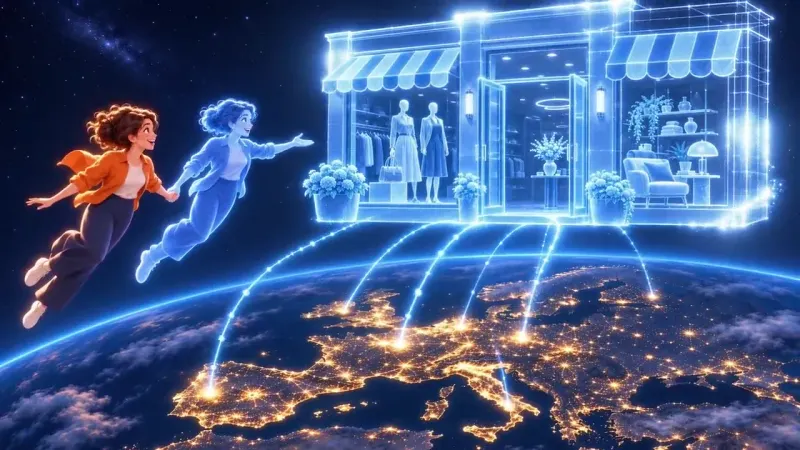
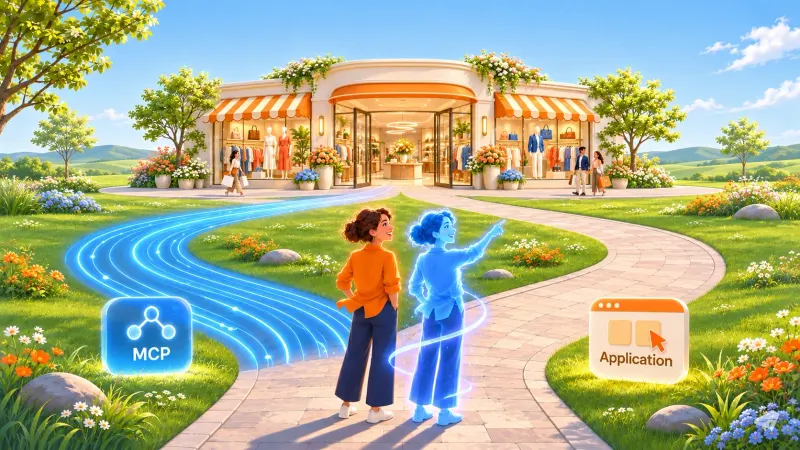
As you can see, nostress covers the first miles. But it is people, with their experience and their abilities, who cover the last mile. They are the ones who make all this possible, today and tomorrow.
What about robots?
Will robots give AI the arms and eyes it lacks? Most likely, there is no denying it. Look at self-driving cars: it is far more laborious than we thought, but we will get there.
So is it all over? Welcoming customers, giving advice, stocking shelves: will we all be replaced by handsome, empathetic robots? Will what holds true for another 10 or 20 years stop being true in the long run?
When we don’t know what will be true in six months, or even a year, predicting 10 or 20 years ahead is magic. We don’t know what technology will do. But we do know what doesn’t change.
What drives our purchases, our preferences, our attachments, our choices is completely irrational. And managing that irrationality every day is what makes an entrepreneur take a decision nobody else would have taken. What makes a customer click with a sales associate. What makes one product sell twice as much as another, with no proof it would succeed, and become the hit of the year.
Some will say algorithms already know how to exploit irrationality. That’s true, on average, based on the past. But the success nobody saw coming is, by definition, not in the data. And the connection between a customer and a sales associate cannot be predicted: it is lived.
It’s not that we want to believe it, it’s our certainty: human nature does not change.
Daring
What AI cannot do, and let’s admit it, not even nostress, is dare. Yet every decision that leads to success contains some degree of daring. And as the saying goes, fortune favors the bold.
What does daring mean? It means taking responsibility for your decision and carrying it. AI can suggest anything, even bold ideas. But it will never carry the responsibility.
Daring also means accepting failure. AI never fails: it is simply wrong. Only humans can fail, and so only humans can succeed.
Failure is not a fault, it is part of the risk. Behind the product that became the hit of the year with no proof, there is someone who dared to sign the purchase order.
Invest in AI, invest in people
The human touch is what makes success. And no one can take that away from you.
So by all means, invest in AI, in nostress ;-) Productivity and efficiency will be two essential weapons for tomorrow. But, counter-intuitively, we will also tell you: invest in people.
Companies, take care to identify your intellectual know-how, the kind that could disappear if young people are no longer there to build up experience. Because if AI replaces juniors, where will tomorrow’s seniors come from? And who will know how to make the most of nostress’s advice?
And don’t forget: without physical reality, there is no financial reality.
Keeping people means keeping warmth and daring. AI and robots are cold-blooded. Humans are not.